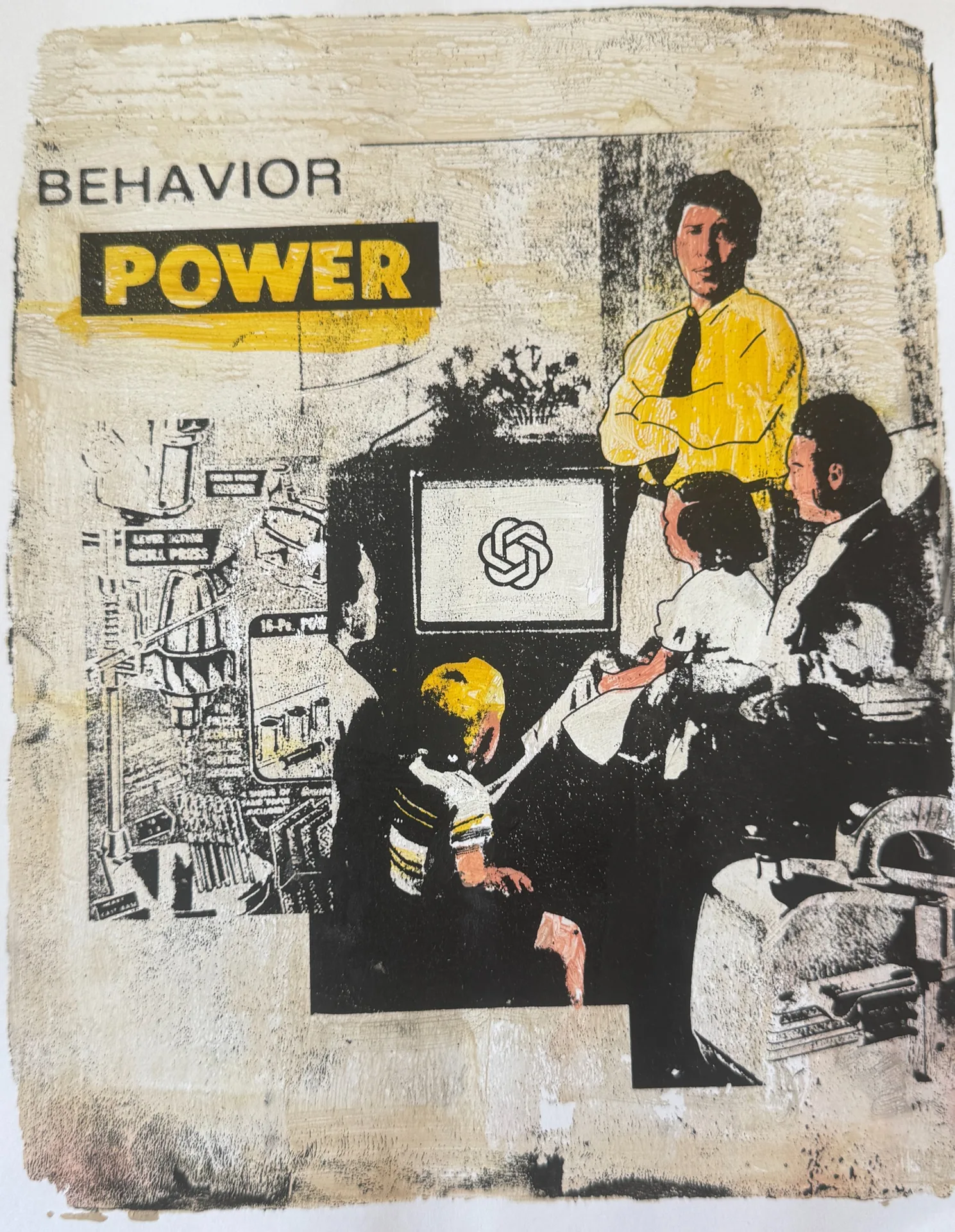
Understanding Hegemony
Hegemony, a term popularised by Italian Marxist philosopher Antonio Gramsci, refers to the dominance of one group over others in society. Hegemony often manifests through the perpetuation of cultural norms, beliefs, and values that serve the interests of the dominant group in a society. It establishes a status quo that seems "natural" or "inevitable", but in reality, it is an intricately designed system that advantages some while disadvantaging others.
Hegemonic structures are interwoven into the fabric of society, influencing all aspects of life, including politics, economy, and social norms. They are perpetuated by a subtle and often unrecognised form of coercion that leads people to accept, adopt, and even perpetuate dominant ideologies, even when these may work against their best interests.
When we look at AI through the lens of hegemony, we can start to see how these powerful technologies can be deployed to maintain and reinforce hegemonic structures. From perpetuating bias, exacerbating environmental inequities, and manipulating "truth", to encroaching on privacy, commodifying data, and influencing human labour markets, AI can, and often does, contribute to these systemic disparities.
Connecting the Dots: Bias, Environment, Human Labour and Datafication
The issue of power and control in AI runs deep. Because of the way AI models are constructed, they are often biased towards a particular "worldview", or disenfranchise already marginalised communities. Take, for example, the structure of a Large Language Model like GPT. The huge dataset contains billions of pages scraped from the web, but the vast majority of the text is in the English language. That content is further biased by the way the data is "crawled" and absorbed into the models. In the words of Emily Bender, Timnit Gebru, and the other authors of the now-famous "Stochastic Parrots" article:
In all cases, the voices of people most likely to hew to a hegemonic viewpoint are also more likely to be retained. In the case of US and UK English, this means that white supremacist and misogynistic, ageist, etc. views are overrepresented in the training data, not only exceeding their prevalence in the general population but also setting up models trained on these datasets to further amplify biases and harms.
Other research has demonstrated that the biases in Artificial Intelligence can particularly discriminate against young, non-white males; that predictive policing algorithms and AI used in the courts can unfairly target black people; and that even attempting to filter or remove bias can inadvertently compound the issue. Companies like OpenAI have been found to use low-paid human labour in countries like Kenya to manually classify and filter toxic and discriminatory data, in yet another example of a powerful, Western company profiting from the labour of poorer communities.
What all this means is that powerful AI across a range of applications from language models to facial recognition and the systems we use to collect data in education can not only reflect but actually reinforce harmful stereotypes and biases.
Even the infrastructure of these systems entrenches existing societal inequalities. The environmental impact of AI particularly affects countries already suffering the effects of the climate crisis. As Bender, Gebru, and their colleagues also pointed out:
These models are being developed at a time when unprecedented environmental changes are being witnessed around the world. It is past time for researchers to prioritize energy efficiency and cost to reduce negative environmental impact and inequitable access to resources, both of which disproportionately affect people who are already in marginalized positions.
AI systems built on large datasets, whether of text, image, population data, or other, can entrench systemic biases. Those systems are built from technologies which contribute to global environmental issues that disproportionately affect poorer countries and already marginalised communities.
And to bring it back to education, the manner in which all of that data is collected and processed, or the datafication of students, compounds these issues further. Research argues that we urgently need to scrutinise the philosophies and principles underpinning education technologies and consider how to promote the ethical use of data, especially in the global south. The collection of data on students, and by extension the use of AI in applications offering "personalised learning", overlooks the diverse cultural, spiritual, and epistemological realities of different communities.
What About Pauses and Open Letters?
The open letter calling for a pause to AI development and the subsequent outcry from various "godfathers" of AI were broadly condemned as both an unsustainable and unrealistic option, and as a self-interested attempt by some to slow down the pace of development to allow their own companies to catch up.
Both the pause and the prophecies of doom from experts have been labelled a distraction from the real issues of AI which could be dealt with right now. Foremost amongst these issues is the distribution of power and the marginalisation of at-risk groups.
For our students, there are many reasons why we should be concerned about AI, and most of those reasons are much more down-to-earth than "because it will destroy the world". As power and wealth continues to be centralised in the hands of leading companies, we need to question the impact AI will have on the workforce and the future lives of our students.
Much like social media and "influencer" work, often attractive to young people who use the platforms, Artificial Intelligence is also built on a lot of "free labour". Just as Facebook and Twitter profit from users contributing hours of unpaid time and their creative and intellectual property, AI is built on data that was never paid for, and trained for free by every person using the platforms.
What Can Be Done About It?
There is no denying that Generative AI and related technologies have the potential to positively impact the education system. The issue, as with all of these technologies, is not whether they can improve learning, but how they are used.
To counteract the entrenchment of existing power structures, and the centralising of wealth in the hands of the already wealthy, seems like a huge challenge. But Artificial Intelligence is not EdTech. It is not an app or a piece of equipment, or even a single system. It is a complex infrastructure that will ultimately be woven through all of the technologies we already use. And importantly, it is not quite fully established in education yet, which gives us an opportunity for critique.
Here are five practical ideas for Teaching AI Ethics:
- Develop Clear Policy: Start with open discussion among staff, students, and community. Define what AI tools are acceptable and regularly review the policy as new challenges arise.
- Data Privacy Activity: Organise a workshop where students dissect the privacy policies of common AI platforms. As a follow-up, students could create "ideal" privacy policies.
- Understanding the Human Labour Behind AI: Initiate study and discussion on the topic of "free labour" in AI, including research on the lives and working conditions of data annotators.
- Interrogating AI Platforms: Assign students to research the Responsible AI policies of various AI platforms and present a report on their findings.
- AI for Good Project: Ask students to design an AI solution for a societal problem they care about, including conducting an Ethical Impact Assessment.